

The Harvest We Were Never Meant to Have
On birth justice, medical violence, and the commodification of Black and Indigenous motherhood & birthwork
By Zetanefert Zipewtu
The United States was built on the labor and the bodies of Black and Indigenous women. This isn't meant to be metaphorical, it's literal. In the 18th and 19th centuries, J. Marion Sims, the man history calls the "father of modern gynecology," conducted surgical experiments on enslaved Black women without anesthesia. He operated on them again and again, with no consent, no anesthesia, he had no regard for their humanity, because the prevailing medical ideology of that time was that Black people did not feel pain the way white people did. We must never forget their names and the harm caused by the men who called themselves physicians. Their names are the ones who should be listed in medical journals, they are the ones who should never be forgotten since the roots of modern gynecology was built on their pain and suffering. Say their names: Anarcha, Betsey, and Lucy. The lie that black people did not feel pain was not accidental. It was structural and profitable. And it has never fully been dismantled.
The forced sterilizations of Indigenous women through the Indian Health Service in the 1960s and 70s are not a footnote or a separate conversation. What happened to them shows the impact and legacy of racist policies. It is estimated that by 1976, between 25% and 50% of Native women had been sterilized, many without their consent, and some without any knowledge that the procedure had taken place.The Puerto Rican women sterilized under La Operación and the Black women in the South coerced under threat of losing welfare benefits, are proof that eugenics in America didn't always wear a hood. It sometimes wore a white coat.
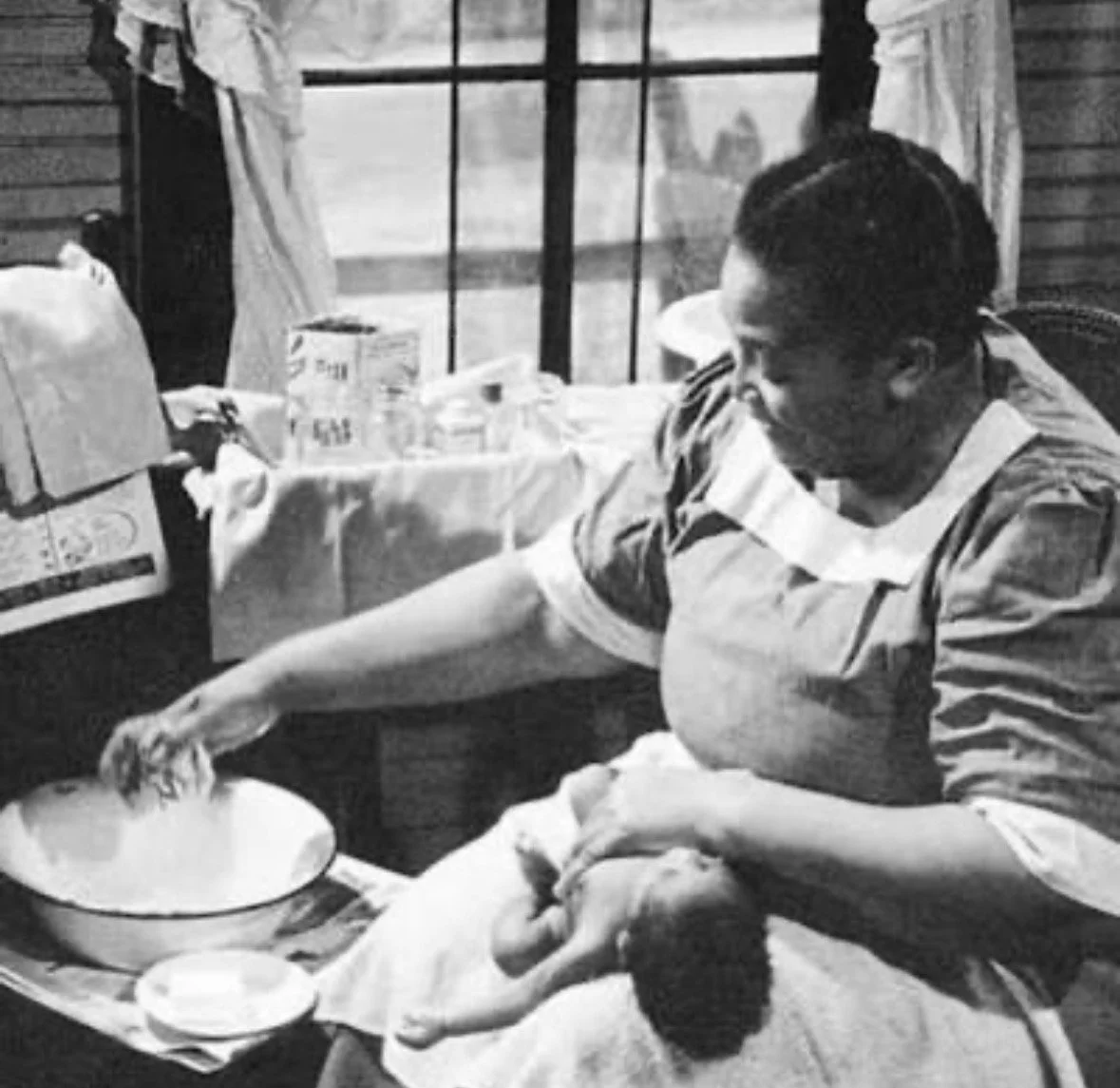
Unfortunately, this is the inheritance of the American medical system, and it has a direct, unbroken line to what we are living through right now. This same system is what pushed granny midwives out of the maternal health space, labeling them as untrained, not qualified, and even dangerous. Although it was widely documented that midwives like Margaret Charles Smith of Alabama never lost a mother.
In 2026, Black women in the United States die from pregnancy-related causes at two to three times the rate of white women. That number does not change when we adjust for income, and it does not budge when you adjust for education. What the research tells us, clearly and repeatedly, is that the determining factor is race, not resources. It is the lived experience of being Black in a medical system that was designed, at its root, to treat our bodies as sites of research and extraction rather than as people deserving of care.
This is the context and I need you to hold it.
Now, let’s talk about what is happening in this moment, in 2026, when "Black maternal health" has become a phrase that opens doors, secures grants, and fills conference rooms. There is an industry forming around our grief. White-led organizations have discovered the Black maternal health crisis the way colonizers discover land that was never empty. They arrive with mission statements and slide decks and a handful of Black and brown birth workers listed under "Our Team," and they call themselves part of the movement. They are able to secure venture capital and build programs inside hospitals, the same ones where Black women are routinely dismissed, sedated into silence, and sent home bleeding. They hire our people as faces and then make decisions without them.They speak our language back to us and call it solidarity.
Let us be precise about what this is. It is the commodification of crisis. It is the monetization of trauma that has never been theirs to sell. When you are funded by venture capitalists, you are not building toward liberation. You are building toward a return on investment. The people who write those checks do not write them for communities. They write them for exits. The system, from the moment our children enter this world, is designed to assert control. Over our birth plans. Over our bodies. Over who is in the room. Over whether we are believed when we say something is wrong. Over whether our babies are taken from us before we have held them. White-led organizations entering the birth justice space wearing the armor of allyship are not outside of that system. They are an extension of it, operating under a more palatable branding.
To be clear, the problem is not partnership. Partnership has always been part of how movements are sustained. The problem is allegiance, and we all know allegiance follows money. When a white-led organization enters into contractual and financial agreements with hospitals and medical providers, a hierarchy is established whether they name it or not. And when the moment of friction comes, because it will, that hierarchy reveals itself. What happens when a doula witnesses an injustice? When she watches a nurse dismiss her client's pain, when she sees a consent form pushed in front of a woman in active labor, when she stands in a room where the medical team is making decisions over a Black body without speaking to the person inside it? What happens when she raises her voice? Does the organization stand with her? Or does the organization, bound by its agreements, bound by its access, bound by its funding relationships with that very institution, decide that she is the problem? Does she get replaced with someone quieter and more palatable? That is not birth justice. That is management.
What white people are doing in health and healing spaces right now is not new. It is the oldest story on this continent. Colonizers do not always arrive with weapons. Sometimes they arrive with curricula. With wellness programs and with 501(c)(3) status and a diversity statement. They enter rooms where the voices of Black and Indigenous people should be the loudest, and they reorder those rooms. Taking up space and gathering knowledge from communities that have been healing themselves for generations, repackage it, and present it back to us as innovation. They claim to want to spread the work while ensuring that they remain at the center of it. This is not allyship. This is appropriation with a budget, and the question we must ask, loudly, is why? Why must you lead what you claim to simply want to support? If the mission is truly the mission, why not get behind the people who have been living it, building it, and bleeding for it? Why not take your platform, your connections, your philanthropic relationships, and use them to amplify the organizations already rooted in these communities? Why not invest your dollars directly instead of positioning yourself as the intermediary between the money and the people? The answer, when you sit with it long enough, is uncomfortable. Because being behind someone is not the same as being in front of them, and some people cannot surrender the front.
Here in Chicago, we are watching this dynamic play out in real time. There are organizations operating in this city, led by physicians and business people who did not come up in these communities or communities who resemble these in other states, they are aggressively expanding their hospital partnerships and positioning themselves as the infrastructure for doula care in this region. We have to ask the question they would rather we didn't. If your model is built around staffing doulas inside hospital systems, and your funding comes from investors who expect a return, who does that model actually serve? Look at where the service is concentrated. Look at who is eligible. When an organization with venture capital backing narrows its focus to Medicaid patients, the optics read as mission-driven. It makes us believe they are serving the most vulnerable. But for those of us who are true thinkers and genuinely invested in birth justice, we can see what is also true: Medicaid pays. And a steady Medicaid reimbursement stream is a very clean answer to the question of how you pay back the people who funded your launch.
We are not saying that Medicaid patients do not deserve doula support because they absolutely do. We are simply saying that the data tells us Black women die at disproportionate rates regardless of their income, regardless of their insurance status, regardless of whether they have a degree on the wall or a gap in coverage. If your model only reaches one economic slice of Black women, your model is not built around the crisis. It is clear to many of us that it is built around the revenue opportunity the crisis has created. Those are very different things, and we deserve organizations that know the difference.
To those who sit in philanthropic spaces, who hold grant committees and program portfolios and the power to direct resources, we see where the money goes. We notice which organizations receive multi-year general operating support and which receive project-restricted funds with 47-page compliance requirements. We've seen who gets invited to the table to advise on funding priorities versus who’s invited only to perform their lived experience. We pay attention. Ensure that your dollars are going to the people in the community, not the organization that hired a few of us. Or the ones who in their haste and greed added a health equity page to their website. Give it to those of us who are in delivery rooms at 3 in the morning, who drive across the South Side to make a postpartum visit happen. The birth workers who are doing this work not because it came up in a strategic planning session but because they have watched their sisters die and decided that would not be the end of the story.
Allow me to tell you who I am. Not because my credentials matter, but because this work is not abstract to me. I am a native of the communities I serve, these neighborhoods often appear in the data as ZIP codes with the highest rates of Black maternal mortality in this state. This crisis, I didn't discover it. As a young girl, I listened to stories of the women in the community talking about how such and such lost her baby. I heard about the mommas who died as a result of giving birth. As a doula, I've watched the racism and mistreatment play out in the birthing space. I am the mother of three Black daughters. When I think about what the statistics say about what they may face when they become pregnant, when I sit with the reality that the country they are growing up in still cannot keep Black mothers alive, there is no distance between my work and my life. This is urgent to me in the way that only a mother who loves her children the way I love mine can understand. My approach was not born in a conference room. It was shaped on the ground, in birth rooms, in postpartum homes, and in West Africa, where I traveled to sit at the feet of indigenous healers and learn what our ancestors knew about bringing life into the world. What I carry from those teachers, that reverence for the body, that understanding of birth as a sacred and sovereign act, lives in every client I serve.
I see the women and their babies as sovereign beings, not as a reimbursement code or as a data point in someone's impact report. Nor do I see them as the means by which I service my debt to an investor class that has never set foot in the rooms where this work happens. My investment has come from the community. These are the people who believed in my vision before it had a name, who poured into me when pouring into me was an act of pure faith. Those are the ones I am accountable to. That is whose trust I carry into every birth.
The birth justice movement belongs to those who built it from the bone. We built it from love, from loss, from ancestral memory, and from the radical insistence that Black life is sacred from the very first breath. We are not handing it over, and we are just getting started.
Organizations like mine, Our Mothers’ Light Birth & Baby Village, Sokana Collective, Chicago Birthworks Collective, BaNia, and Chicago Volunteer Doulas are doing this work. Each of these organizations are showing up to serve their communities with care, justice, love, ingenuity, and grit. Will we be pushed out and forced to the margins while white led organizations overtake the market? Will this be a repeat of what our foremothers had to endure? To this I say, no!